
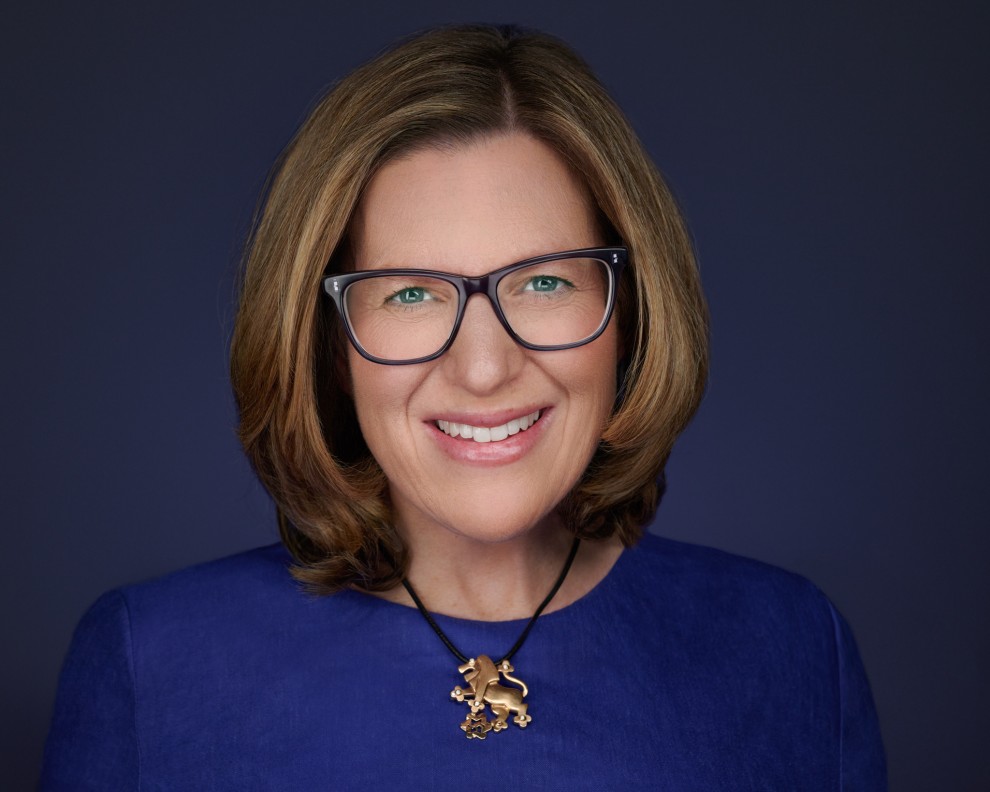
Our Women of Impact profile features a local woman making a notable impact in our community. For this issue, we spoke with Jill Dulitsky of West Hartford, who grew up in Madison, Connecticut. Jill spent roughly a decade in investment banking and corporate finance, before moving into the family auto dealership business. A member of Temple Sinai in Newington, she rose through the congregation’s leadership team as treasurer, executive vice president, and president before her time in Federation’s Community Leadership Initiative opened the door to broader communal involvement. She has since served Jewish Federation of Greater Hartford as Chair of Women’s Philanthropy and Board Chair, and now chairs the Jewish Community Relations Council. Jill and her husband, Rob, have endowed their annual gift to Federation, ensuring their support continues for generations to come. The couple have two grown children, Brady, 22, and Carly, 21.
What role has your Jewishness played in your life, and has that changed over time?
I grew up with two Jewish parents in a very non-Jewish town. I like to say that I knew the ‘Our Father’ prayer as much as the Shema, because if I stayed at a friend’s house on Friday night, I’d go to church with them on Saturday. In fact, my first year of religious school was held at the Catholic elementary school because we didn’t have a building yet.
My paternal grandparents were the center of Jewish tradition for us; every holiday was around their table, including long Passover Seders. Both my mother and my grandmother instilled Jewish values in us and made sure we continued the traditions despite the modernity of our life and assimilation in Madison. The value of tikkun olam was really important in my house. My mom took part in a Martin Luther King, Jr. “I Have a Dream” program in New Haven, and has mentored a young woman she met through that program for more than 20 years. She’s become a close friend of hers and an integral part of our family. Even in my 20s, when I wasn’t so involved in organized Jewish religion, the values I learned when I was young carried through. When my husband and I met and moved to Seattle, we went to a Federation event for young Jewish professionals, and that really re-upped our involvement in Jewish life—which continues to this day.
When did you make the decision to get involved in the Jewish community in a leadership role?
I like to say that I’m an accidental volunteer. Our treasurer at Temple Sinai was moving, and my husband let me know that the Temple president was going to ask me to take the role. I told him I’m too busy and I’m not taking it—but when I got the call, I said yes within three minutes. It’s really about saying yes. Later on, [then Federation Board Chair] Carolyn Gitlin called and asked if I’d consider becoming Women’s Philanthropy Chair. I said, “I’m not really involved in Federation right now.” And she said that’s exactly why they wanted me. “You have fresh ideas.” So, I said yes and threw myself wholeheartedly into it. Like any commitment, I took it really seriously from there on in.
Your involvement with your shul eventually led you to join the Jewish Leadership Academy’s Community Leadership Initiative (CLI). What was your experience with that program?
Life changing. When I was very involved with Temple Sinai, I didn’t really have an understanding of how our broader community worked. If it weren’t for CLI, I wouldn’t have become Women’s Philanthropy Chair or Board Chair for Federation. My husband and I wouldn’t have endowed our annual gift. And there’s two reasons it had that impact: One, simply the nature of the CLI cohort. When you get to learn and study with such a unique group of people from throughout the community, from every level of observance, and even live together for a week when you take your CLI trip—ours was to Israel—the veneer of professionalism and the need to be perfect falls away and you learn to just be yourself as a cohort. The second reason is the program itself. [Program organizer] Heather Fiedler is a brilliant programmer. I’d had a business coach for ten years in my professional life, but Heather is teaching through a Jewish lens; many years later, I’m still quoting her and the speakers she brought in.
You served as Federation’s Board Chair on October 7. Tell us about your experiences that day.
Actually, I’d been Federation Board Chair for just one month to the day on October 7. I woke up at 5:30 a.m., which I never do, and turned on the news, which is how I found out about the attacks. Remember, this happened on both Shabbat and Simchat Torah. [Immediate past board chair] Dana Keller called me and said, “You need to go to [Federation President & CEO] David Waren’s house,” who is Shabbat observant. Ten minutes later I’m standing at his door and about to knock, and I vividly remember thinking, “Our lives are about to change. There will be before this knock, and after.” David came to the door and I told him, “Hamas bombed Israel and the country’s at war.” And everything took off from there.
Now three years later, how did that day change your sense of responsibility to the Jewish community?
The post-Holocaust generation, who largely saved the Jewish people, are either very elderly or gone. And I think there’s a time that every human experiences in their life when you look around and realize, “Oh, it’s me now. There’s no other generation who is going to take action.” We’re there now. I have no delusions of grandeur that I can change the world—but I can have an impact right here in Hartford County, in the 32 towns Federation represents. But look, I’m not special—I have no special skillset or magic powers. We all can have that impact. And to me, if we all do our part, our impact comes together like a mosaic. I’ll give you an example: We’ve all been shocked by the rise of antisemitism. And the stories I hear right here in Greater Hartford—a Jewish kid getting spit on in high school, or someone being called a dirty Jew—this is the result of the world blaming Jews for every one of its ills. When I hear that, I feel an obligation; in fact, we all have an obligation.
I think it’s realistic to acknowledge that one way to make an impact is through philanthropic giving. You and your husband recently decided to endow your gift to Federation’s Annual Campaign. How does that fit into your sense of communal responsibility?
A strong community takes money, and we don’t always love talking about that part. Also, there’s often a generosity gap in this country around supporting the administrative backbone of an organization—people naturally want to fund the flashy, direct-impact programs, but if we don’t pay our staff properly and help them grow, the work won’t survive on volunteers alone. My husband and I feel that, as the convener of this community, there’s no more important organization than Federation, and it will always be my primary philanthropic home, alongside the other causes I support.
I worry about what happens when this generation, and the one above mine, are no longer here. The giving landscape has shifted: people don’t trust institutions the way they used to, and there’s real assimilation in the Jewish world. I don’t think it's a given that we can sustain a $5 or $6 million annual campaign twenty years from now. So my husband and I decided our gift needed to exist in perpetuity. We allocated a portion of our retirement funds, and there are tools like life insurance policies that make it possible without touching current income. It doesn’t matter whether the gift is $500 or $500,000—every endowed dollar strengthens that same foundation. If we do it here, and Western Mass. does it, and New Haven does it, and New York does it, that’s a mosaic that holds the Jewish world together.
If you could talk to an earlier version of yourself, before the call about becoming Temple Sinai’s treasurer, what would you say to her?
Just say yes. You’ll get back way more than you give. I’ve had the honor to work with the most amazing professionals—[former Federation Associate VP of Development] Laurie Mandell, [VP of Impact & Strategy] Heather Fiedler, and, of course, David Waren—and it’s such a gift. Saying yes has also given me a community that is entirely intergenerational, with different levels of observancy, and a wide diversity of opinions. We have a very big tent and it’s welcoming to everyone. Just say yes.